
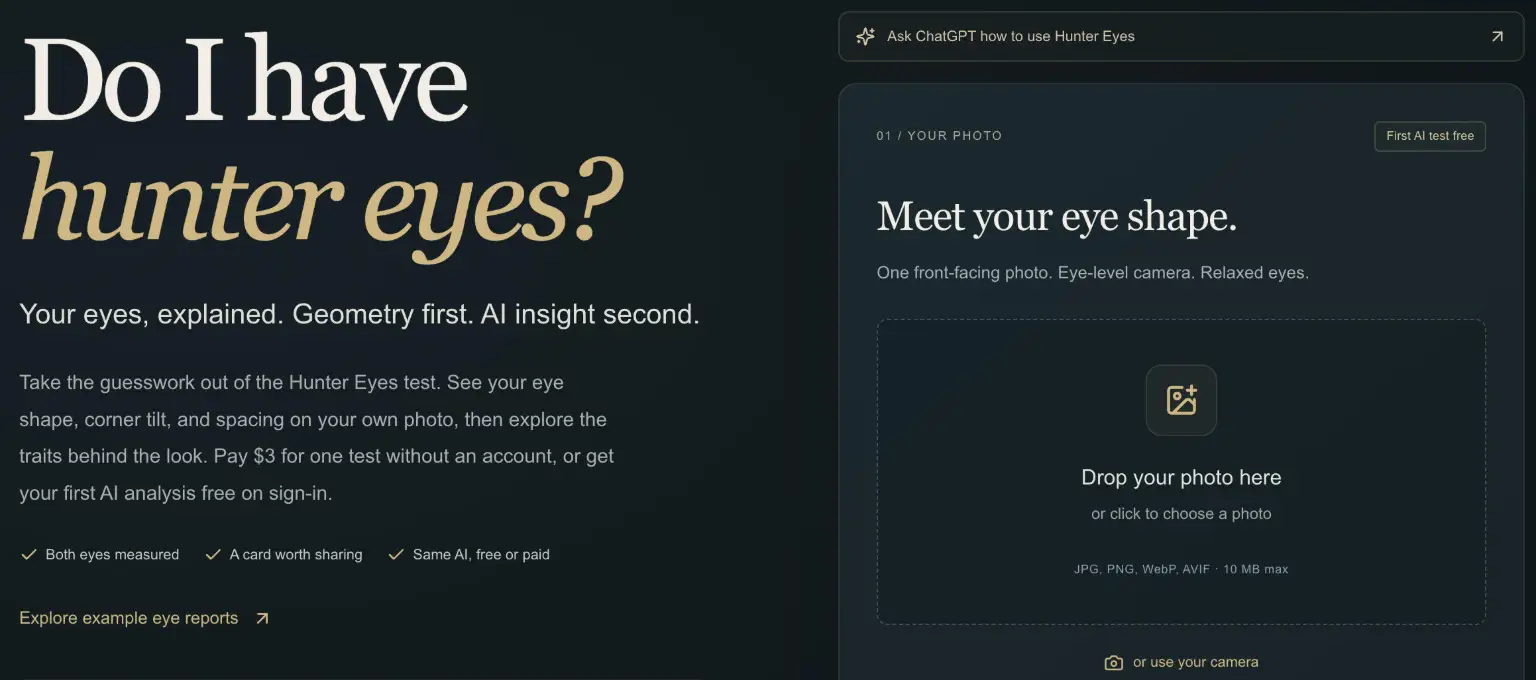
Find Out If You Have Hunter Eyes
Have you ever wondered why some eyes look sharp, narrow, and naturally intense while others appear rounder and more open? You may have heard people call these features Hunter Eyes.
Want to find out where your own eye shape fits?
Try the Hunter Eyes Test at HunterEyes.net. Upload a photo and use AI-powered eye analysis to explore your eye proportions, canthal tilt, eyelid exposure, brow structure, and other characteristics associated with hunter eyes.
What you can discover:
- Eye Shape Analysis: Understand whether your eyes look round, almond-shaped, or elongated.
- Canthal Tilt: Explore the angle of your inner and outer eye corners.
- Eyelid Analysis: Examine upper and lower eyelid characteristics.
- Brow Structure: Explore how your brow area frames your eyes.
- AI Eye Analysis: Get a personalized breakdown of your visible eye features.
Take the Hunter Eyes Test → https://huntereyes.net/
Your results are an AI-generated appearance analysis for entertainment and personal exploration, not a medical diagnosis or scientifically validated attractiveness score.
What Are Hunter Eyes?
Hunter eyes are a popular term in facial aesthetics and looksmaxxing communities. It describes an eye area that looks relatively narrow, elongated, and deep-set, often creating an intense or focused appearance.
The phrase has become especially popular on social media platforms such as TikTok, Reddit, and Instagram, where people compare facial features and discuss different eye shapes.
When people talk about hunter eyes, they usually refer to a combination of characteristics rather than one specific measurement.
These commonly include:
- Positive or neutral canthal tilt.
- Almond-shaped or elongated eye openings.
- Relatively low upper-eyelid exposure.
- A straighter lower eyelid.
- A deep-set appearance.
- A prominent or closely positioned brow.
Not everyone who has one of these characteristics has the complete look commonly described as hunter eyes.
It is also important to understand that hunter eyes is not an official medical classification. There is no scientifically established score or universal threshold that determines whether someone has hunter eyes.
The term is best understood as an informal description of several visible eye-area features.
What Makes Hunter Eyes Attractive?
Why do people discuss hunter eyes so frequently?
One reason is the visual impression created by a combination of eye shape, eyelid structure, and brow positioning.
Hunter eyes are often associated with:
1. A Defined Eye Area
Narrower, elongated eye openings can create a more angular appearance compared with rounder eyes.
2. A Focused Expression
Limited upper-eyelid exposure and a relatively straight lower lid may create an intense-looking expression.
3. Strong Brow Framing
A prominent brow area can make the eyes appear more deeply set and visually defined.
4. Facial Harmony
The eye area does not exist independently. Its appearance is influenced by the eyebrows, forehead, nose, cheekbones, and overall facial proportions.
However, hunter eyes are not universally considered more attractive. Personal preferences, cultural influences, and individual facial harmony all matter.
6 Main Hunter Eyes Characteristics
To understand whether you have hunter eyes, it helps to look at the individual characteristics instead of relying on a single label.
1. Positive Canthal Tilt
Canthal tilt is the angle between the inner and outer corners of your eyes.
A positive canthal tilt means the outer corner sits higher than the inner corner.
This is one of the most frequently discussed features of hunter eyes.
A neutral tilt means the corners are approximately level, while a negative canthal tilt means the outer corner sits lower.
Although positive canthal tilt is commonly associated with hunter eyes, it does not automatically mean someone has this eye type.
2. Almond or Elongated Eye Shape
Hunter eyes are often described as almond-shaped or elongated.
These eyes generally have a longer horizontal opening relative to their vertical height.
Rounder eyes tend to have a more vertically open appearance, while elongated eyes look narrower.
Eye-opening proportions are useful for describing eye shape, but they are only one part of the overall appearance.
3. Low Upper Eyelid Exposure
Upper-eyelid exposure refers to how much upper eyelid skin is visible above the eyelashes.
Hunter eyes are commonly associated with relatively little visible upper eyelid space.
In some cases, the upper eyelid slightly overlaps the top of the iris, contributing to a compact appearance.
This feature can also overlap with hooded eyes, although hooded eyelids and hunter eyes are not the same thing.
4. Straight Lower Eyelid
The lower eyelid is another important part of the hunter eyes appearance.
A relatively straight lower eyelid can make the eye opening appear narrower and less rounded.
Some descriptions of hunter eyes also mention limited lower scleral show, meaning less visible white below the iris.
5. Deep-Set Eyes
Deep-set eyes appear to sit farther back within the eye socket.
They can create natural shadows around the upper eyelids, especially when combined with a prominent brow ridge.
This contributes to the intense appearance often associated with hunter eyes.
However, photographs cannot reliably establish actual orbital depth. Lighting and camera position can make eyes look more or less deep-set.
6. Brow Position and Structure
The eyebrows help frame the eye area.
A relatively close brow-to-eye distance and a defined brow ridge can reinforce the compact appearance.
Thick eyebrows alone do not mean someone has hunter eyes. The relationship between the brows, eyelids, and eye opening is more important.
Hunter Eyes vs Prey Eyes: What's the Difference?
One of the most popular comparisons in looksmaxxing discussions is Hunter Eyes vs Prey Eyes.
These terms describe two contrasting visual styles.
Hunter eyes generally refer to a narrower, more compact eye area, while prey eyes are commonly used to describe rounder, more open-looking eyes.
Here is a simple comparison:
| Feature | Hunter Eyes | Prey Eyes |
|---|---|---|
| Eye shape | Narrow or elongated | Rounder or more open |
| Canthal tilt | Often positive or neutral | Often neutral or negative |
| Upper eyelid | Less visible | More visible |
| Lower eyelid | Relatively straight | Often more curved |
| Scleral show | Often limited | May be more noticeable |
| Brow appearance | Closer-looking brow | More open brow-to-eye area |
| Overall impression | Focused and intense | Open and expressive |
These are general descriptions, not strict anatomical rules.
For example, someone can have almond-shaped eyes with a neutral canthal tilt, or round eyes with positive canthal tilt.
Real eye anatomy exists on a spectrum. There are no two biological categories that divide everyone into hunter eyes and prey eyes.
Prey Eyes vs Hunter Eyes: Which Is Better?
There is no objective answer.
Some people prefer a narrow, intense appearance, while others prefer larger, rounder eyes that create a softer expression.
Facial attractiveness is influenced by the entire face, not simply the shape of the eyes.
Instead of trying to fit into one category, consider understanding your individual eye characteristics.
Do I Have Hunter Eyes? How to Check Your Eye Shape
If you have searched for Do I Have Hunter Eyes, you are probably trying to figure out whether your own eye features match the popular description.
You can start with a simple visual assessment.
Step 1: Look at Your Canthal Tilt
Look at the inner and outer corners of both eyes.
Are the outer corners higher, approximately level, or lower than the inner corners?
Remember that head position can affect how the angle looks in a photograph.
Step 2: Examine Your Eye Shape
Do your eyes appear relatively narrow and horizontally elongated?
Or do they have a more rounded, vertically open shape?
Look at the natural outline rather than deliberately squinting.
Step 3: Check Upper Eyelid Exposure
Observe how much upper eyelid skin is visible when your face is relaxed.
Limited upper eyelid exposure is frequently associated with hunter eyes.
Step 4: Look at Your Lower Eyelids
Notice whether your lower eyelids appear relatively straight or curved.
Also check whether there is visible white beneath your iris.
Step 5: Consider Your Brow Structure
Look at the distance between your eyebrows and your eyes.
A closer-looking brow and natural shadow can contribute to the deep-set appearance.
Try an AI Hunter Eyes Test
If manually checking these characteristics is difficult, you can use an online tool.
HunterEyes.net helps you explore your eye geometry and visible eye-area features using a photo.
The analysis can help you understand characteristics such as:
- Eye-opening proportions.
- Left and right canthal tilt.
- Eye spacing.
- Upper eyelid exposure.
- Lower eyelid appearance.
- Brow framing and deep-set appearance.
Check Your Hunter Eyes Online →
For more consistent results, use a clear, front-facing photo with neutral expression, even lighting, and your camera positioned at eye level.
How to Get Hunter Eyes: What Actually Works?
Another common search is How to Get Hunter Eyes.
Many online discussions suggest exercises, mewing, weight loss, or other techniques. However, it is important to distinguish between changing how your eyes look and changing their underlying anatomy.
The structures that determine eye-corner position and orbital shape are largely anatomical.
There is no established at-home method that can reliably transform someone's natural eye structure into hunter eyes.
Here are some realistic options.
1. Improve Your Eyebrow Styling
Your eyebrows can significantly influence how your eyes are framed.
Experimenting with a flatter eyebrow shape or subtle grooming may create a more defined appearance.
You can try different styles with makeup before making permanent grooming changes.
2. Pay Attention to Sleep and Temporary Puffiness
Lack of sleep and allergies can contribute to temporary puffiness around the eyes.
Getting sufficient rest and managing known allergies appropriately may help your eye area look less swollen.
These habits do not change your natural canthal tilt or orbital structure.
3. Explore Makeup and Styling
Makeup can create the visual impression of more elongated eyes.
For example, subtle eyeliner along the outer corner can make the eye area appear more extended.
These are styling techniques rather than anatomical changes.
4. Understand Lighting and Photography
Lighting can dramatically change how your eye area looks.
Directional lighting may emphasize brow shadows, while balanced front lighting can reveal the natural shape of your eyes more clearly.
Camera height, head angle, and facial expression also influence the result.
5. Avoid Unsupported Eye Exercises
You may see online tutorials recommending squint training, eye exercises, or repeated facial movements to achieve hunter eyes.
There is no good scientific evidence that these methods reposition the canthal tendons or reshape adult orbital bones.
Forcing your eyes into a squint does not permanently change their structure.
Avoid pressing, pulling, or striking the eye area. These practices can cause injury.
6. Be Careful With Cosmetic Procedures
Some medical procedures can alter eyelid position or the outer eye corners.
However, these procedures carry potential risks and cannot guarantee a particular informal aesthetic category.
Anyone considering an eye-area procedure should consult a qualified oculoplastic surgeon for an individualized assessment.
You should never feel that surgery or an extreme lifestyle change is necessary to achieve a particular online eye label.
Hunter Eyes Men: Why Is This Feature Popular?
The keyword Hunter Eyes Men is particularly popular in men's facial aesthetics and looksmaxxing discussions.
Hunter eyes are often associated online with a masculine appearance because the combination of a compact eye opening, defined brow area, and deep-set impression can create a strong facial frame.
When discussing hunter eyes in men, people commonly focus on:
- A relatively prominent brow ridge.
- Limited upper-eyelid exposure.
- A narrow or elongated eye opening.
- Positive or neutral canthal tilt.
- A relatively straight lower eyelid.
- A defined relationship between the eyebrows and eyes.
However, thick eyebrows or a prominent brow ridge alone do not establish whether someone has hunter eyes.
It is also worth noting that these features are not exclusive to men. People of any gender can have similar eye anatomy.
Hunter eyes do not measure testosterone, personality, confidence, or masculinity. They describe an informal appearance preference, not a biological ranking.
Do I Have Hunter Eyes Meme: Why Is It So Popular?
If you have searched for Do I Have Hunter Eyes Meme or Hunter Eyes Meme, you may have noticed that the phrase is frequently used in online jokes.
The meme often involves someone posting a selfie and asking whether they have hunter eyes.
Other variations include:
- Exaggerated squinting to imitate hunter eyes.
- Comparing hunter eyes and prey eyes in side-by-side images.
- Using filters to make eyes look narrower.
- Posting dramatic facial expressions with the caption "Do I have hunter eyes?"
- Joking about whether a particular facial feature qualifies someone as a hunter.
The humor comes from how seriously some internet communities discuss tiny differences in facial features.
For example, someone might post a completely ordinary selfie and receive comments debating their canthal tilt, eyelid exposure, or eye spacing.
Why Does the Hunter Eyes Meme Exist?
The meme is closely connected to the broader looksmaxxing trend.
Looksmaxxing communities often classify facial features using specific terminology, measurements, and aesthetic labels.
Hunter eyes became one of the most recognizable terms because the concept is easy to illustrate through photographs.
The contrast between hunter eyes and prey eyes also creates an easy format for comparison memes.
However, a meme or edited photograph is not a reliable way to evaluate someone's actual eye anatomy.
An exaggerated squint, camera angle, or image filter can make almost anyone's eyes appear different.
Hunter Eyes vs Almond Eyes vs Hooded Eyes
These terms are sometimes confused because they can describe overlapping characteristics.
Hunter Eyes: An informal combination of eye-area features, including narrow proportions, limited upper-eyelid exposure, and a deep-set appearance.
Almond Eyes: A description of eye shape. The opening is generally elongated horizontally, with tapered inner and outer corners.
Hooded Eyes: An eyelid characteristic in which skin from the upper eyelid or brow area partially covers the crease.
Someone can have almond-shaped, hooded eyes without having all the characteristics associated with hunter eyes.
Likewise, someone can have hunter-like eye proportions without strongly hooded eyelids.
Understanding these differences makes it easier to describe your natural eye shape accurately.
Frequently Asked Questions
What are hunter eyes?
Hunter eyes are an informal facial aesthetics term describing a compact, narrow-looking eye area, often associated with positive canthal tilt, low upper-eyelid exposure, a relatively straight lower lid, and deep-set eyes.
What is hunter eyes?
Hunter eyes refers to an eye appearance commonly discussed in looksmaxxing communities. It is not a medical classification, and there is no universally accepted numerical threshold.
How do I know if I have hunter eyes?
Look at your eye-opening proportions, canthal tilt, eyelid exposure, lower eyelid shape, and brow structure. You can also use HunterEyes.net to explore these characteristics through AI-powered photo analysis.
How to get hunter eyes naturally?
There is no proven natural method to change your orbital bones or reposition your canthal tendons. Grooming, makeup, lighting, and ordinary care for temporary puffiness can change how your eyes appear, but not their underlying anatomy.
Are hunter eyes genetic?
Many of the structural characteristics associated with hunter eyes are influenced by genetics, including eyelid anatomy, canthal position, and orbital structure. Expression, age, temporary swelling, and photography can also influence their appearance.
Hunter eyes vs prey eyes: which is more attractive?
Neither is universally more attractive. Hunter eyes and prey eyes are informal appearance labels, and individual preferences vary. Overall facial harmony matters more than fitting a particular category.
Are hunter eyes only found in men?
No. People of any gender can have the characteristics commonly associated with hunter eyes. The term is especially popular in men's looksmaxxing communities, but the underlying eye features are not exclusive to men.
Is the hunter eyes meme serious?
Sometimes, but often it is used humorously. People use the phrase to joke about facial aesthetics, exaggerated squinting, and online comparisons between hunter eyes and prey eyes.
Can AI tell if I have hunter eyes?
AI can analyze visible features in a photograph, including eye proportions, canthal tilt, and eyelid appearance. However, photo-based analysis has limitations and cannot reliably determine every three-dimensional anatomical characteristic.
Can mewing give you hunter eyes?
There is no established scientific evidence that mewing changes adult orbital structure, canthal position, or natural eye shape.
Final Thoughts: Understand Your Natural Eye Shape
Hunter eyes have become one of the most recognizable terms in online facial aesthetics.
Whether you discovered the term through a looksmaxxing discussion, a hunter eyes meme, or a comparison of hunter vs prey eyes, understanding the individual features is more useful than chasing a single label.
Canthal tilt, eye-opening proportions, eyelid exposure, and brow structure all contribute to how your eyes look.
If you are curious about your own characteristics, you can explore them with an AI-powered analysis tool.
Try HunterEyes.net to discover your eye shape, explore your proportions, and better understand your natural eye features.
Your eye shape is one part of your face, not a measure of your worth.